Core model
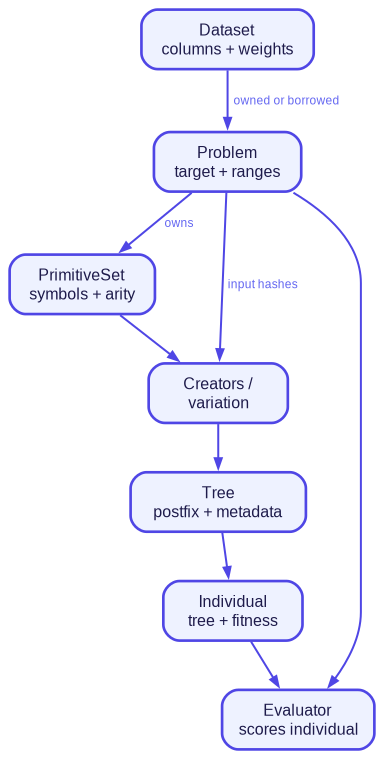
Model objects
| Type | Role | Key contract |
|---|---|---|
Dataset |
named numeric columns and optional row weights | owning datasets pad columns for SIMD; Wrap is zero-copy and requires caller-owned, padded column-major storage |
Problem |
target, input hashes, data splits, primitive set, linear-scaling policy | it borrows or owns the dataset; changing the target resets default inputs |
PrimitiveSet |
enabled terminals/functions, frequencies, arity bounds | configure before concurrent creation; mutation during cache reads is unsupported |
Tree |
postfix node sequence and derived metadata | call UpdateNodes() after structural edits; Validate() checks representation invariants without evaluating |
Individual |
genotype plus minimization objectives | Rank and Distance are NSGA-II state, not intrinsic tree properties |
Tree representation
Operon stores a complete expression in postfix order. A function node consumes contiguous completed child subtrees before it; the final node is the root. Each node caches structural metadata—length, depth, parent, level, and hash—derived from that order. Tree::UpdateNodes() refreshes it after a structural change. Tree::Validate() reports the first violated invariant, including malformed function arity, non-backward references, multiple roots, and stale metadata.
Constants with Optimize == true are the coefficient vector used by optimizers and interpreters. GetCoefficients() reads them in tree order; SetCoefficients() requires the matching order and count. A caller that changes only coefficients does not need UpdateNodes().
Problem formulation
Construct a Problem after the dataset, set the target and ranges, then select inputs and primitives. SetDefaultInputs() selects every column other than the target; SetInputs() instead fixes an explicit hash/name set. Training, test, and validation ranges are independent. Evaluation normally uses the training range; consumers must select another range explicitly when reporting holdout quality.
Problem also owns the PrimitiveSet and the linear-scaling policy, because both alter the model formulation rather than the mechanics of one evaluator.