Execution
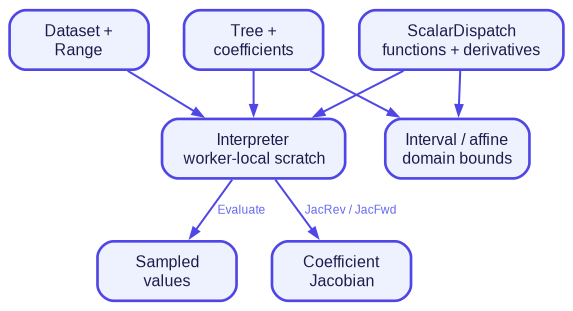
Execution paths
Interpreter<T, DTable> binds a tree, dataset, dispatch table, and row range. TryEvaluate(coefficients, range, output) is the non-throwing path: it returns tl::expected with InterpreterError for a missing variable/function or an incorrectly sized output span. The throwing Evaluate overloads format and throw that error.
| Need | API |
|---|---|
| sampled model values | TryEvaluate / Evaluate |
| coefficient Jacobian for local fitting | TryJacRev, JacRev, JacFwd, JacFwd |
| derivative with respect to an input column | JacRevVariable / JacFwdVariable |
| enclosure over a domain box | IntervalEvaluator or AffineEvaluator |
The Jacobian has one row per requested data row and one column per optimizable constant. It is not a derivative with respect to inputs; use the variable-Jacobian APIs for that.
Dispatch and custom functions
The dispatch table maps node hashes to scalar callables and, where needed, derivatives. Register a custom callable in ScalarDispatch, then expose its hash and arity to generation with PrimitiveSet::AddFunction; registering only one side produces a tree that cannot be generated or executed. The custom primitives example shows the complete pairing.
Sampling is not certification
Sampled evaluation measures rows selected by a Range; it says nothing about points between rows. Interval and affine evaluators instead propagate enclosures through the same tree over a domain box. They can prove a bound, but dependency over-approximation can make an actually valid expression uncertifiable. Use sampled execution for loss and bounds for whole-domain claims; do not infer one from the other.