System overview
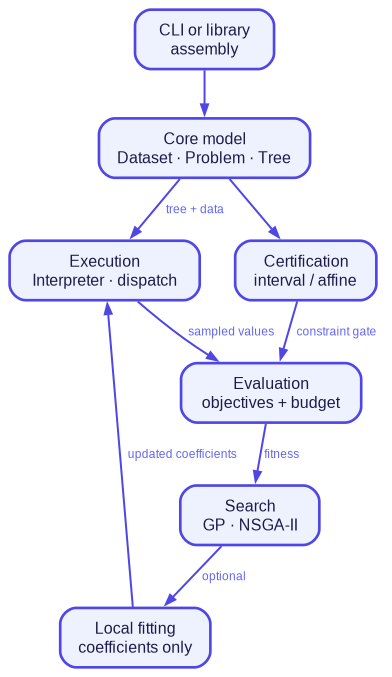
Subsystems and ownership
| Layer | Owns | Depends on |
|---|---|---|
| Core | datasets, problem definition, postfix trees, primitive vocabulary | no search state |
| Execution | dispatch binding, sampled values, coefficient Jacobians, interval/affine bounds | Tree, Dataset, dispatch table |
| Evaluation | objective values, evaluation budget, objective count | Problem, interpreter or another evaluator |
| Search | population, initialization, offspring, reinsertion, stopping | evaluator and operators |
| Optimization | numeric coefficients only | tree, problem, dispatch table |
The CLI programs assemble these objects; they are not a separate execution path. Library integrations can use the same composition directly.
Lifetime and concurrency
Problem either owns its Dataset or borrows one; every component receiving a Problem const* therefore requires the problem—and its dataset—to outlive it. Evaluators and algorithms are held by pointer and are not value-like configuration objects.
An Interpreter lazily binds a tree and range into mutable scratch state, so one interpreter instance is required per concurrent worker. The search APIs accept a Taskflow executor for the same reason: parallel work is scheduled by the algorithm while worker-local execution state stays isolated.
Stable boundary
Individual carries a Tree, fitness vector, rank, and crowding distance. Search sees the fitness vector and comparison; execution sees the tree and coefficients. Keep this boundary intact when extending Operon—attaching search-specific state to the tree makes reuse by enumeration, shape certification, and formatting fragile.