Architecture overview
Operon separates problem formulation, symbolic programs, execution, objectives, and search. A tree is the only model exchanged between those layers; a Problem carries the data-dependent context.
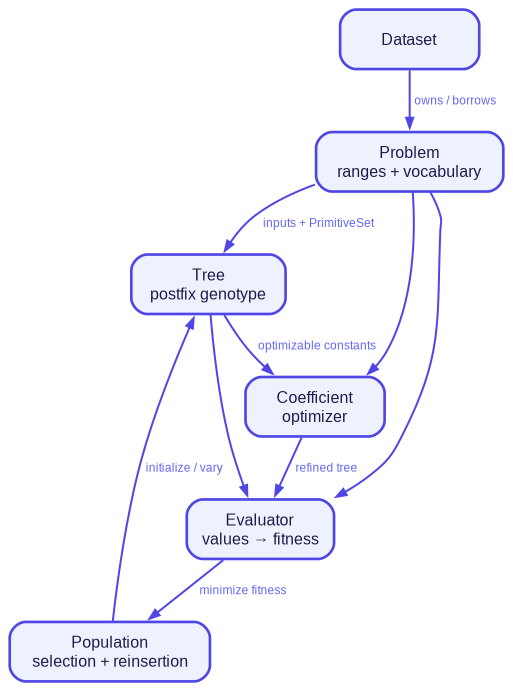
Data and control flow
Datasetstores column-major observations;Problemselects a target, inputs, row ranges, and aPrimitiveSet.- Initializers and variation operators create postfix
Treegenotypes using that primitive vocabulary. - An
EvaluatorBaseoptionally interprets a tree over the training range, then emits a minimization fitness vector for anIndividual. - Selection, offspring generation, reinsertion, and either GP or NSGA-II own the population transition. A coefficient optimizer may improve only the tree's optimizable constants before it is scored.
This split is deliberate: changing a loss, an interpreter backend, or a search operator does not require a second expression format or a second data model.
Choose an integration boundary
| Need | Extension point |
|---|---|
| Different columns, ranges, target, or vocabulary | Dataset, Problem, PrimitiveSet |
| Custom scalar function | ScalarDispatch registration plus PrimitiveSet::AddFunction |
| Different objective or multiple objectives | EvaluatorBase::Score / composite evaluator |
| Different local coefficient fit | OptimizerBase |
| Different population behavior | creator, selector, mutation, crossover, reinserter, or algorithm |
The API reference describes these contracts. The guides explain when to use them and which invariants the interfaces do not enforce for callers.