Search and optimization
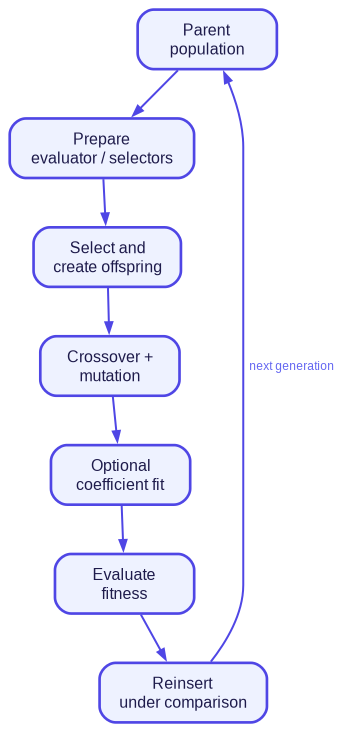
Population transition
The GP and NSGA-II drivers share the same operator boundary. Initializers create valid trees, an offspring generator selects parents and applies crossover/mutation, optional local search changes coefficients, then the evaluator assigns fitness before reinsertion. The algorithm—not the operators—owns the population and stopping configuration.
| Concern | Main types |
|---|---|
| tree construction | BalancedTreeCreator, TreeInitializerBase, coefficient initializers |
| variation | SubtreeCrossover, MultiMutation, mutation operators |
| parent choice | TournamentSelector and comparison callback |
| local search | CoefficientOptimizer, OptimizerBase |
| survival | reinserters and comparison callback |
| drivers | GeneticProgrammingAlgorithm, NSGA2 |
GeneticAlgorithmConfig bounds generations, evaluations, iterations, population size, pool size, and seed. Its evaluation budget is consumed by evaluator work—not by offspring attempts—so operators should not embed untracked objective calculations.
Fitness and ordering
Fitness is a minimization vector. Single-objective GP commonly uses SingleObjectiveComparison; NSGA-II computes Rank and Distance and uses crowded comparison. ParetoComparison assumes minimization in every dimension. A custom comparator must be consistent for selection and reinsertion or the search transition no longer has a coherent ordering.
FeasibilityFirstComparison can order valid trees before invalid ones independently of their score. It is complementary to shape evaluator worst-value substitution; choose it when feasibility should remain explicit instead of being encoded in a penalty.
Coefficient optimization
CoefficientOptimizer delegates to an OptimizerBase, usually LevenbergMarquardtOptimizer. It changes only Optimize constants in the tree. FitOutcome distinguishes an improving fit, a valid non-improving fit, an interpreter evaluation error, and a configuration error; Diagnostics(outcome) is available in every case. Treat an unsuccessful local fit as a candidate-level result, not as a reason to discard the structural tree before normal evaluation.