Evaluation
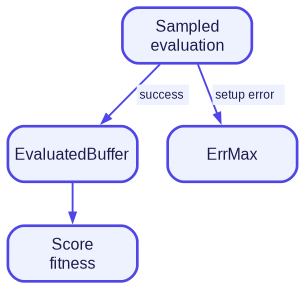
Two-phase evaluator contract
EvaluatorBase::operator() is final and always composes Evaluate(individual, scratch) followed by Score(context, evaluated). Value-based evaluators override Evaluate to fill a caller-supplied scratch span and return an EvaluatedBuffer; objective-only evaluators may return nullopt and compute directly in Score.
EvaluatedBuffer is move-only evidence that a particular scratch span contains output for a particular Individual. A Score implementation must retrieve values through evaluated->Values(ctx.Ind, ctx.Scratch), not read the scratch span directly. This catches a common composite-evaluator bug: scoring stale output from a different genotype.
| Event | Result |
|---|---|
Evaluate succeeds |
Score produces one or more minimization objectives |
Evaluate returns an interpreter error |
final operator() increments CallCount and returns ErrMax |
| no sampled values are required | Evaluate returns nullopt; Score owns the objective |
Built-in objective building blocks
Evaluator<DTable> performs sampled interpretation and scores an ErrorMetric such as SSE, MSE, NMSE, RMSE, MAE, R2, or C2. FitLeastSquares supplies linear scaling coefficients. Information criteria and weighted complexity evaluators can be composed into multi-objective fitness vectors.
Every standard error metric follows the algorithm's minimization convention. If an external score has “larger is better” semantics, transform it before exposing it as an objective or supply a comparison consistent with it.
Budgets and preparation
ObjectiveCount() tells population algorithms the required fitness-vector width. Prepare(population) is the per-generation hook for cached or population-level state; shape-constrained evaluation uses it to prewarm feasibility. ResidualEvaluations, JacobianEvaluations, and CallCount are atomic counters. A custom evaluator must account for its own Score call exactly once and should preserve the base failure behavior rather than translating execution errors into ordinary scores.