Grammar enumeration
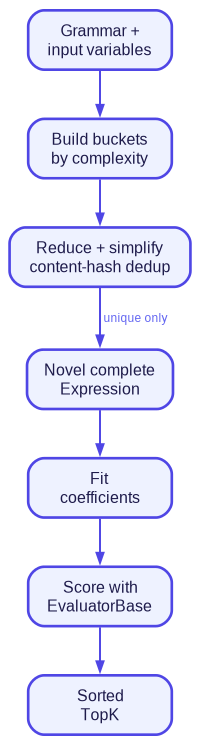
What is enumerated
EnumerationEngine performs bottom-up dynamic programming over an Operon::Grammar. For each nonterminal and symbolic-complexity budget it constructs candidate postfix trees, then calls Reduce(), Simplify(), and content-hash deduplication before storing a bucket. Complexity counts every non-constant node; free constants are fitted parameters, not structural complexity.
The engine visits budgets in increasing order. SetOnNovelExpression() receives only newly inserted complete Expression trees, not grammar intermediates. Use that hook for work that must happen exactly once per unique candidate.
Top-level algorithm
GrammarEnumerationAlgorithm connects the engine to an OptimizerBase and an EvaluatorBase. It fits coefficients for each novel expression, scores it with the evaluator, and keeps the ascending-fitness TopK entries returned by BestTrees(). This separates fitting loss from ranking objective: a least-squares optimizer can be paired with a different evaluator metric.
| Configuration | Effect |
|---|---|
EnumerationConfig::MaxComplexity |
maximum caller-visible structural complexity |
EnumerationConfig::TopK |
number of best scored trees retained |
Run(rng, report) |
single-shot build, fit, score, and retain |
RequestStop() or report == true |
stops after the current completed complexity level |
Run() is intentionally single-shot: buckets and deduplication state are retained, and the engine is not resettable. Construct a new algorithm for another enumeration. Enumeration can grow combinatorially; use it when the grammar and complexity limit are tractable, not as a drop-in replacement for a large population search.